
Pulsed Signal Therapy (PST) in Thane
PST full form in medical terms: Pulsed Signal Therapy — also written as pulse signal therapy, and known in Europe as Electromagnetic Regeneration Therapy (EMRT). It is a non-invasive treatment that uses precisely pulsed electromagnetic signals to stimulate the body’s own repair of cartilage, bone, tendons, ligaments, and the joint capsule.
Developed and patented by Dr. Richard Markoll, an American physician and biophysicist of German origin, PST has been used extensively across Europe for healing damaged joint structures — cartilage, intervertebral discs, bone, tendon attachment points, and ligaments — and in the treatment of osteoarthritis, osteoporosis, stress fractures, and the mal-union of broken bones.
PST is available in Thane at Dr. Sahil’s Advanced Physiotherapy Clinic, one of the few centres in India offering this therapy. On this page: how PST works, the science of the regeneration process, conditions treated, what a course costs, who should avoid it, and answers to the questions patients ask us most.

What Is Pulsed Signal Therapy and How Does It Work?
To understand PST, start with how a healthy joint maintains itself. Research has shown that when stress is placed on a joint, a low-power electrical signal is created within the cartilage. This natural signal tells the body to repair damaged or worn tissue and to maintain the health and proper functioning of the joint. With aging, injury, or disease, this signalling is disturbed — the repair instruction weakens, and degeneration outpaces regeneration.
PST recreates that missing instruction. The device directs a series of magnetic pulses through the injured tissue, and each pulse carries a tiny electrical signal that stimulates cellular repair. What makes the technology unique is the role of the magnetic field: unlike traditional magnetic field therapy, in PST the magnetic field serves only as the carrier for the electrically pulsed signals. The field allows those signals to penetrate the injury unchanged — without it, the pulsating signals would be distorted by the varying density of the surrounding tissue (skin, muscle, fat, bone).
The signal itself is not a generic buzz. The PST device generates a pure, unidirectional magnetic field using biological frequencies below 30 Hz, with a quasi-rectangular waveform at low field strengths. The unhealthy tissue is treated with impulses that constantly change in intensity and duration — mimicking the body’s own variable repair signalling rather than repeating one fixed pattern, which is precisely where PST differs from ordinary PEMF machines.
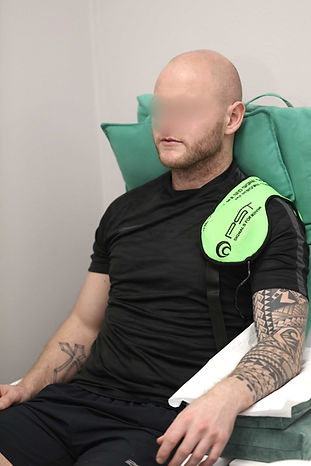
What a session looks like: treatment is administered in 9–12 sessions of 60 minutes each, conducted under the supervision of a trained PST therapist. You sit or lie comfortably with the affected joint positioned inside the treatment coil. The therapy is completely painless — no injections, no medication, no downtime — and most patients read or rest during the session.
Pulsed electromagnetic fields have been used since the 1970s for non-union fractures and osteoarthritis pain, with success rates reported around 70–80% in several countries. Because most early claims were based on varied devices with inconsistent parameters, PST was developed as an effort to determine whether a pulsed field with specific, biologically matched parameters could deliver superior and more consistent results.
The Regeneration Process — What Happens Inside the Joint
This is the science behind the therapy, and it is worth understanding because it explains both why PST works and why results continue building after the course ends.
Bone and cartilage tissues carry natural electromagnetic bio-potentials that are crucial to the formation and dynamic adaptation of the tissue. When a joint is subjected to compressive stress, water within the cartilage matrix is displaced along with sodium ions, leaving the negative charges of proteoglycan molecules unneutralised. Through a mechanism called mechanical-electrical transduction, this mechanical stimulus is transformed into a weak electric current — the streaming potential — which is thought to be the main signal instructing cartilage cells (chondrocytes) to increase their synthesis of proteoglycans and collagen, the structural building blocks of cartilage.
If the streaming potential is the signal for chondrocytes to produce new matrix, the same effect can be obtained by exposing the joint to an electromagnetic field that produces currents mimicking the organism’s own. That is exactly what PST does: it forces a migration of positively charged hydrogen ions (H+) within the negatively charged extracellular matrix, recreating the physiological repair stimulus.
Laboratory work supports the mechanism: tissue cultures of chondrocytes stimulated by PST have shown markedly higher cartilage production. PST also stimulates fibroblasts — the cells that produce connective tissue — which is why the therapy works across all connective tissue types: bone, cartilage, ligament, tendon, and collagen.
The documented effects of a PST course include:
- Early improvement in joint function — mobility and flexibility — through the removal of muscular tension, with normalised joint kinematics and reduced pain
- Acceleration of healing in injuries to joint-related structures such as ligaments and tendon attachments
- Stimulation of chondrocyte activity via streaming potentials, with regeneration of cartilage tissue
- Stimulation of osteoblast activity through piezoelectric potentials, supporting stabilisation of bone thickness and density
Because the therapy triggers biological repair rather than masking symptoms, improvement typically continues for 6–8 weeks after the final session as the stimulated tissue regenerates
Conditions Treated with PST
PST, while effective in bone tissue, finds its main indication in the treatment of cartilage, soft tissue, and connective tissue. The conditions we treat with PST at our Thane clinic:
Osteoarthritis (knee, hip, spine, shoulder, hands). The most common and most responsive indication. In a healthy joint, the cartilage layer covering the bone ends is strong, smooth, and flexible — it absorbs the stresses placed on the joint and protects the bone from damage. In osteoarthritis this cartilage becomes brittle, thin, and pitted, and can eventually wear through completely; the bone underneath thickens and broadens, producing pain and restricted movement, particularly in large joints like the hip and knee. PST targets this process directly: by stimulating chondrocytes to regenerate cartilage, it can improve joint structure and help stabilise the joint’s synovial fluid, improving overall joint function — without medication or surgery.
Osteoporosis and osteopenia. In India, roughly 1 in 3 women and 1 in 5 men above 50 suffer from osteoporosis — a silent disease usually diagnosed only after a fracture occurs. Bone is living tissue, constantly removed and replaced; with age, more is lost than replaced. As a treatment for osteoporosis, EMRT is a natural alternative to medication: it re-stimulates osteoblast (bone-forming cell) activity to replace bone loss, and helps retain proteoglycan and chondrocyte composition within bone and the cartilage between bones. Reported benefits include increased bone quality, pain reduction, improved physical resilience, and increased joint function and range of movement in the spine and hips.
Sports injuries. Ligament injuries, tendon attachment problems (tennis elbow, golfer’s elbow), repetitive stress injuries, and stress fractures. As a rule, sports injuries heal in a few weeks — but sometimes pain persists and full joint function doesn’t return. In these cases PST supports the natural evolution of the trauma as a non-invasive alternative or adjunct. In our clinical experience, adding PST can meaningfully shorten healing time: Grade II ankle sprains that typically need 3–4 weeks have recovered within about 2 weeks — a natural heal, without the adverse effects associated with repeated injections and medication.
Back and neck pain from disc and joint degeneration — including cervical and lumbar spondylosis and intervertebral disc problems.
Slow-healing and non-union fractures — supporting bone consolidation where healing has stalled.
Frozen shoulder and chronic joint stiffness — as part of a structured rehabilitation plan.
If you’re unsure whether your condition is suitable, our team assesses every patient first — PST is only recommended where it is clinically appropriate, and we will tell you honestly if it isn’t.
What Does PST Treatment Cost in Thane?
A full PST course consists of 9–12 one-hour sessions, usually on consecutive days. Because PST is a specialised therapy available at very few centres in India, patients frequently ask about pricing before visiting.
At Dr. Sahil’s Advanced Physiotherapy Clinic, PST is priced per course rather than per session; the exact cost depends on the joint being treated and the number of sessions your assessment indicates. Contact us for current pricing — we keep PST significantly more affordable than surgical alternatives, and you receive a clear, fixed quote after assessment with no hidden charges.
Call: +91 90297 31346 | WhatsApp us | Book an assessment
Who Should Avoid PST? (Contraindications)
PST is painless and has no known side effects for suitable patients, but it is not for everyone. PST is NOT recommended if you:
- Have a cardiac pacemaker, implanted defibrillator, or other electronic implant
- Are pregnant
- Have an active infection or tumour in the treatment area
- Have untreated severe heart rhythm disorders
- Are a child or adolescent whose growth plates have not yet closed (assessed case by case)
During your assessment we review your full medical history to confirm PST is safe and appropriate for you.
Why Choose Dr. Sahil's Advanced Physiotherapy Clinic for PST?
We are among the very few centres in India offering original Pulsed Signal Therapy, treating patients in Thane since 2012. PST here is never a standalone gadget treatment: it is integrated into a complete rehabilitation plan designed by qualified physiotherapists, and where requested we coordinate with your referring doctor or physical therapist for follow-up — so the joint you heal stays healthy.
PST is available at our Siddhachal (Pokhran Road) clinic. Patients visit us from across Thane — Ghodbunder Road, Manpada, Majiwada, Kolshet — and from Mumbai and Navi Mumbai specifically for this therapy.
(Outstation or international patient? Book an online consultation first — we’ll review your reports and tell you honestly whether a PST course is worth travelling for.)
A standard course is 9–12 sessions of one hour each, typically on consecutive days, under the supervision of a trained PST therapist. Your physiotherapist confirms the exact number after assessing your joint.
No. PST is completely painless — most patients feel nothing during the session and read or rest while the treatment runs. There are no injections and no downtime.
Some patients notice improved mobility and reduced pain during the course itself, but because PST works by stimulating biological repair, improvement typically continues for 6–8 weeks after the course ends as the tissue regenerates.
They are related but not identical. Ordinary magnetic field (PEMF) therapy applies a generic field. In PST, the magnetic field is only the carrier for specific, biologically matched pulsed signals (unidirectional frequencies below 30 Hz, constantly varying in intensity and duration) designed to reproduce the body’s natural cartilage-repair signals.
For early to moderate osteoarthritis, many patients use PST to reduce pain and improve function, potentially delaying or avoiding surgery. For advanced, bone-on-bone arthritis we will tell you honestly if PST is unlikely to help — surgery is sometimes the right answer, and we assess each case individually.
PST has no known side effects in suitable patients. It is not used for people with pacemakers or electronic implants, during pregnancy, or over active infections or tumours.
At Dr. Sahil’s Advanced Physiotherapy Clinic, Siddhachal (Pokharan Road No. 2, near Vasant Vihar School), Thane West. Call +91 90297 31346 to book an assessment.
In physiotherapy and rehabilitation, PST stands for Pulsed Signal Therapy, also known as Electromagnetic Regeneration Therapy (EMRT) — a non-invasive treatment using biologically matched pulsed electromagnetic signals to stimulate repair of cartilage, bone, and connective tissue. (PST can mean other things in unrelated medical contexts, but in joint and pain treatment it refers to Pulsed Signal Therapy.)
PST was developed and patented by Dr. Richard Markoll, an American physician and biophysicist of German origin. His research refined general PEMF therapy into a specific, biologically matched signal protocol, and PST has since been used extensively across Europe.