
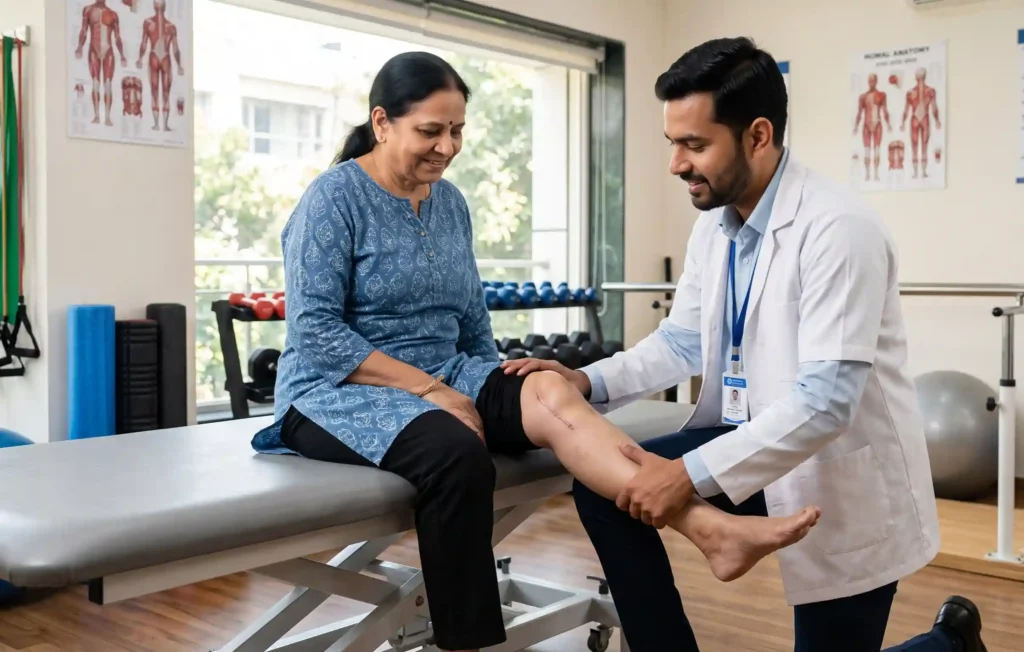
Every week at our clinic, I meet patients who’ve just come home after a Total Knee Replacement (TKR) from Jupiter Hospital, Bethany, or Hiranandani and they all have the same look that that surgery is done and now no more pain.
The surgeon has done their part. Now the actual real work begins.
Physiotherapy after knee replacement isn’t a formality. It’s the single biggest factor that determines how well your new knee actually performs six months from now. You can have the best implant the money can buy, placed by the finest,skilled orthopaedic surgeon in Thane or Mumbai and still end up with a stiff, painful knee if rehabilitation is neglected or done incorrectly.
This is the guide I wish every TKR patient had before coming home.
Why Physiotherapy After TKR Isn’t Optional
There’s a common misconception we physios encounter regularly. Patients assume the surgery “fixes” the knee, and physiotherapy is just some gentle exercise to speed things up. Most of the time orthopedic Drs they themselves show exercises that can be done at home and they literally tell them there is no need for physiotherapy. Really! That’s not how it works.
When a surgeon performs a Total Knee Replacement, they’re essentially removing the damaged joint surfaces and replacing them with metal and plastic components. The muscles, tendons, and ligaments around the knee which have been compensating for years of arthritis pain are now suddenly working with a completely new mechanical structure. They don’t automatically adjust.
In one such case of mine, almost 3–4 years back, we treated a patient in our clinic who had undergone a total knee replacement on his right knee. He was told that post-surgery there would be no need for physiotherapy. On his surgeon’s advice, he ignored professional physiotherapy or I should say, a planned exercise program and was simply given a printout of exercises to do at home, which he did follow.
To his surprise, however, it wasn’t helping him. After a month, he went for a follow-up visit to raise his concerns with the surgeon, but the surgeon told him that he had done his part and now the patient just needed to do physio.
When he finally visited us, the knee was already in a stiff position and his bending was limited to 90 degrees. While 90 degrees is okay for basic walking, to tell you the truth, it’s not really OK you will still face restrictions in many daily activities. Our normal knee bending is around 120 to 130 degrees, so this patient had another 30 degrees left to achieve.
During therapy, we could feel the physical restriction; because the home exercises hadn’t been done through the full range of motion, adhesion formation had set in, limiting his movement. It took us a full month of targeted therapy to regain the rest of his range of motion and strength, after which the patient finally realized the mistake he had made post-surgery. Not to blame anyone, but that is simply the reality of it.
Without structured rehabilitation, you risk:
- Scar tissue forming inside the joint (called arthrofibrosis), permanently limiting how far the knee bends
- Quadriceps weakness that makes stairs, getting off the floor, or standing from a chair genuinely difficult sometimes for years
- Altered walking patterns that put stress on your hip and lower back
- Deep vein thrombosis (DVT) risk, which is a serious complication
The goal of physiotherapy is not just to get you walking. It’s to restore normal muscle control, full range of motion, and confident, pain-free movement in daily life.
When Does Physiotherapy Start? (Earlier Than You Think)
Most patients are surprised to learn that physiotherapy begins within 24 to 48 hours of surgery sometimes on the same day. This isn’t aggressive; it’s evidence-based and you cannot deny it.
When the movement is started immediately after TKR, it reduces swelling, prevents blood clots, and keeps the joint from stiffening up. Your physiotherapist will visit you in the ward and guide you through ankle pumps, gentle knee bending, and getting to a standing position with support. It feels like a lot to handle post-surgery but it’s also exactly what the joint needs.
Once discharged typically 3 to 5 days after surgery for most patients in private hospitals rehabilitation continues either at a physiotherapy clinic or through home visits.
When I used to do hospital visits for TKR patients, we used to go through the patient’s summary to check for any special instructions given by the surgeon as at times they do advise going gentle initially, and later, based on the patient’s bearing capacity, we can progress to a bit more active physio. But until the sutures are removed, we stick to gentle physiotherapy.
During the visit, we always inspect the surgical site for any signs of inflammation, redness, or swelling, and assess the available range of motion. Initially, we ask patients to perform the movement on their own while we offer slight assistance, allowing us to gauge both their pain threshold and their current range.
At first, patients are fearful that it might hurt a lot, but with proper counseling, they gain confidence and when they actually see themselves moving the joint, they feel truly happy.
The Week-by-Week Recovery Timeline
Recovery from TKR isn’t a straight line. There will be good days when there is no pain and frustrating ones when you feel a lot of pain and stiffness . Here’s a realistic, honest breakdown of what to expect:
Week 1–2: Swelling Control and Basic Mobility
This phase is about managing pain and swelling while starting gentle movement. The knee will look swollen and bruised this is completely normal. Icing for 15–20 minutes after every exercise session helps significantly.
Key exercises at this stage:
- Ankle pumps — done frequently throughout the day to prevent clots
- Knee slides (heel slides) — sliding the heel toward you while lying down, gradually increasing the bend
- Quadriceps setting — tightening the thigh muscle without moving the knee
- Assisted standing — getting up with support, initially with a walker
Target range of motion by end of week 2: approximately 60–70 degrees of knee bend.
Week 3–6: Strength Building and Increasing Independence
The swelling starts to settle. This is when physiotherapy sessions become more structured and demanding. Patients often feel more confident which is good, but it also means they push too hard and overdo it.
Exercises added in this phase:
- Straight leg raises — builds quadriceps without stressing the joint
- Standing knee bends — holding a support and bending the knee
- Step training — starting with a low step, focusing on control rather than speed
- Short-arc squats — partial squats against a wall, progressing gradually
Target range of motion by week 6: 90–100 degrees minimum. If this isn’t achieved, manual therapy is often needed to break down early scar tissue.
As I explained earlier, some cases come to us very late, while others even when starting therapy on time still develop joint stiffness. That’s just how the body is, it’s unpredictable at times, and it can be difficult to explain to the patient why. To this, I have only one answer: every body type is different, and your baseline fitness, mobility, and strength before surgery directly impact your recovery.
In such cases, we use manual mobilization, which can be painful, but is extremely effective, and patients are always happy with the end results. For patients who are stuck at 70 to 80 degrees of bending, we follow a targeted approach:
- Soft Tissue Release: We start by releasing the tight surrounding tissues to reduce overall tension before working on the joint itself.
- Manual Knee Mobilization: We take the knee to its currently achieved range and then apply gentle, controlled pressure beyond that point to gain a new range. Once that new range is established, we hold it, let the joint adapt, and gradually push a bit further. It can be painful at times, but we always build in adequate rest intervals to allow the patient to recover.
- Patellar (Kneecap) Mobilization: Because the kneecap must glide smoothly for the knee to bend properly, stiff patellar tendons or deep scar tissue around the kneecap can severely limit range of motion. We manually mobilize the patella to restore that essential movement.
- Mobilization with Movement (MWM): We apply manual joint glides while the patient actively bends the knee—a highly effective concept developed by physical therapist Brian Mulligan.
- Hold-Relax Techniques: We utilize these Neuromuscular Facilitation (PNF) stretching methods to help relax the guard muscles, break through movement barriers, and gain painless extra degrees of flexion.
It takes effort, but breaking through these stiffness barriers is what gets the patient moving freely again.
Week 6–12: Functional Recovery
By this point, most patients are walking without a walker and managing daily tasks. The focus shifts to functional movement — stairs, getting in and out of a car, low squats for Indian toilets and floor sitting, and building endurance for longer walks.
This is also the phase where patients often stop physiotherapy prematurely. The knee feels “good enough.” But good enough isn’t full recovery.
Target range of motion by week 12: 110–120 degrees. This is the benchmark needed for comfortable stair climbing, sitting in a low chair, and getting up from the floor.
3–6 Months: Long-Term Strength and Confidence
Full muscular recovery after TKR takes 3 to 6 months sometimes longer for older patients or those who had severe arthritis for years. Exercises in this phase focus on building quadriceps and glute strength, improving balance, and returning to activities like walking on uneven surfaces, light gardening, and even gentle swimming.
You need to understand your body and respect your age as well. If a patient hasn’t exercised much throughout their lifetime, their recovery will naturally be slower and it may take months to build up strength but it is by no means impossible.
There is strong research and clinical evidence showing that there is no age limit when it comes to gaining strength. So, don’t lose hope you just need to stay consistent with your exercises. We have seen our own patients fully recover their mobility and get back to their daily walking routine along the shores of Upvan Lake in Thane.
Yes, even stair climbing becomes as smooth as the good old days! We even train our patients to sit cross-legged for pooja and bend into a proper sitting position for namaz. They were so deeply happy to be able to kneel down in front of their Almighty for prayers again and seeing that level of joy in them is a completely different level of happiness for us
The Problem With “Standard” Physiotherapy After TKR
Here’s something I’ll say frankly: not all post-TKR physiotherapy is equal.
Generic exercise sheets given by well-meaning physiotherapists or worse, printed handouts from the hospital are no substitute for hands-on assessment. Every patient presents differently. A 65-year-old who had severe bilateral arthritis for 12 years needs a very different approach than a 55-year-old who had the surgery following a ligament injury.
At our clinic, we assess:
- How much swelling is present and where
- The actual range of motion (not estimated — measured in degrees with a goniometer)
- Which muscle groups are most inhibited
- Gait pattern — how the patient is walking and which compensations have already developed
- Pain levels at rest vs. during movement
Treatment then combines manual therapy (joint mobilisation, soft tissue work), targeted exercise progression, and electrotherapy modalities like ultrasound where needed. We adjust the protocol every session based on how the knee responds.
Home Visits vs. Clinic-Based Physiotherapy — Which Is Better?
For the first two to three weeks after discharge, home-based physiotherapy is often the safer and more practical choice. Getting into a car, traveling to a clinic, and climbing stairs are genuinely difficult in the early post-operative phase.
Our team provides home visits across Thane West — including Siddhachal, Ghodbunder Road, Naupada, Manpada, Kasarvadavali, Majiwada, and Kolshet Road — with portable equipment for assessment and basic treatment.
After week 3 or 4, transitioning to clinic-based sessions is beneficial because:
- More equipment is available (parallel bars, resistance bands, steps for stair training)
- Group accountability often motivates patients to push a little harder
- Complex manual therapy techniques are easier to perform on a proper plinth
Many of our TKR patients start with home visits and transition to the clinic as their confidence and mobility improve. We coordinate closely with surgeons at Jupiter, Bethany, and Hiranandani for follow-up alignment.
Red Flags — When to Call Your Physiotherapist or Surgeon Immediately
Know these warning signs. Don’t wait for your next scheduled appointment if you notice:
- Sudden increase in swelling that doesn’t settle with icing and elevation
- Redness or warmth spreading around the incision
- Fever above 38.5°C
- Calf pain or swelling in the leg (possible DVT — call immediately)
- The knee giving way or feeling unstable
- Clicking or grinding that’s new and accompanied by pain
We’ve also had cases where patients developed an infection of unknown origin. The patient initially started experiencing episodes of fever that wouldn’t subside even after taking antipyretic medications. While these are rare scenarios, they do happen occasionally—often due to a weakened immune system, which makes a person more susceptible to infections.
When we noticed the fever along with increasing swelling and redness around the site, we immediately advised the patient to report it to the surgeon. Upon evaluation, an infection was confirmed. This early detection allowed the surgical team to stop the infection in its tracks using targeted antibiotics. During that period, our physiotherapy sessions were temporarily put on hold, as the primary goal was to bring the infection fully under control before resuming rehabilitation
Common Mistakes Patients Make After TKR
After treating dozens of post-TKR patients in Thane over the years, these are the patterns I see repeatedly:
Stopping physiotherapy too early. The knee feels okay at 6 weeks, so sessions stop. Six months later, the patient has persistent stiffness and weakness that could have been avoided.
Doing too much too soon. Pain after exercise is a signal. Some patients interpret “push through the discomfort” as license to overdo it, leading to excessive swelling and setbacks.
Ignoring the hip and ankle. The knee doesn’t work in isolation. Weakness above (hip abductors, glutes) and below (calf, ankle stability) directly affects how the knee loads and moves. A good physiotherapy programme addresses the whole lower limb.
Relying entirely on painkillers to exercise. Masking pain with medication before sessions means you lose accurate feedback about what the joint can and cannot tolerate at that point in recovery.
Book Your Post-TKR Physiotherapy Assessment in Thane
If you or a family member has had or is preparing for a knee replacement, early planning matters. The first physiotherapy session should ideally be arranged before the surgery so the rehabilitation programme can begin within 24–48 hours of discharge.
We have three clinic locations across Thane: Siddhachal (Pokharan Road 2), Naupada (near Revival Hospital), and Kasarvadavali. Home visits are available across Thane West.
Call 9029731346 to speak directly with our team and arrange your post-operative assessment.
Dr. Sahil’s Advanced Physiotherapy Clinic has been providing specialist physiotherapy in Thane since 2012, with expertise in post-surgical rehabilitation, cardiorespiratory physiotherapy, and neuro rehabilitation.
Q: How long does physiotherapy take after knee replacement?
A: Most patients need physiotherapy for 6 to 12 weeks after a Total Knee Replacement. However, complete muscular recovery takes 3 to 6 months. The first 2 weeks focus on controling the swelling and basic mobility. Weeks 3 to 6 focus on strength building. From week 6 onwards, the focus shifts to functional recovery stairs, sitting on floor crossleg, longer walks, and returning to daily activities. At Dr. Sahil’s clinic in Thane, we tailor the programme duration to each patient’s progress rather than following a fixed number of sessions.
Q: When can I start walking after knee replacement?
A: Most patient start walking within 24 to 48 hours of surgery sometimes on the same day. Walking with a walker typically begins in the hospital ward. By week 2 to 3, most patients are walking short distances at home with minimal support. By week 6, most can walk independently indoors. Outdoor walking on uneven surfaces and longer distances is usually comfortable by week 10 to 12. The timeline varies based on age, pre-surgery fitness, and how consistently physiotherapy is done.
Q: Do you offer home physiotherapy after knee replacement in Thane?
A: Yes. For the first 2 to 3 weeks after discharge, home visits are often the most practical option since traveling to a clinic can be difficult post-surgery. Dr. Sahil’s Advanced Physiotherapy Clinic provides home visits across Thane West including Siddhachal, Ghodbunder Road, Naupada, Manpada, Kasarvadavali, Majiwada, and Kolshet Road. Our physiotherapists bring portable equipment for assessment and treatment. After week 3 or 4, we typically recommend transitioning to clinic-based sessions for access to full equipment and more advanced rehabilitation. Call 9029731346 to arrange your home visit.
Q: What is the range of motion target after knee replacement?
A: Range of motion targets after TKR are measured in degrees of knee bend (flexion). By end of week 2, the target is approximately 60 to 70 degrees. By week 6, the knee should reach 90 to 100 degrees minimum enough to climb stairs and sit comfortably in a chair. By week 12, the target is 110 to 120 degrees, which allows for activities like getting in and out of a car, sitting cross-legged, and using an Indian toilet comfortably. If range of motion is not progressing as expected, manual therapy and joint mobilisation techniques are used to break down scar tissue and restore movement.
Q: What happens if I skip physiotherapy after knee replacement?
A: Skipping or delaying physiotherapy after TKR significantly increases the risk of poor outcomes and stiff knee. Without guided rehabilitation, scar tissue can form inside the joint a condition called arthrofibrosis which permanently limits how far the knee bends. Quadriceps muscles, which are weakened by surgery, do not recover on their own and can leave the knee feeling unstable for years. Walking patterns also suffer, putting abnormal stress on the hip, opposite knee, and lower back. In some cases, patients who skip early physiotherapy require a procedure called Manipulation Under Anaesthesia (MUA) to forcibly break down scar tissue an entirely avoidable complication with proper rehabilitation.